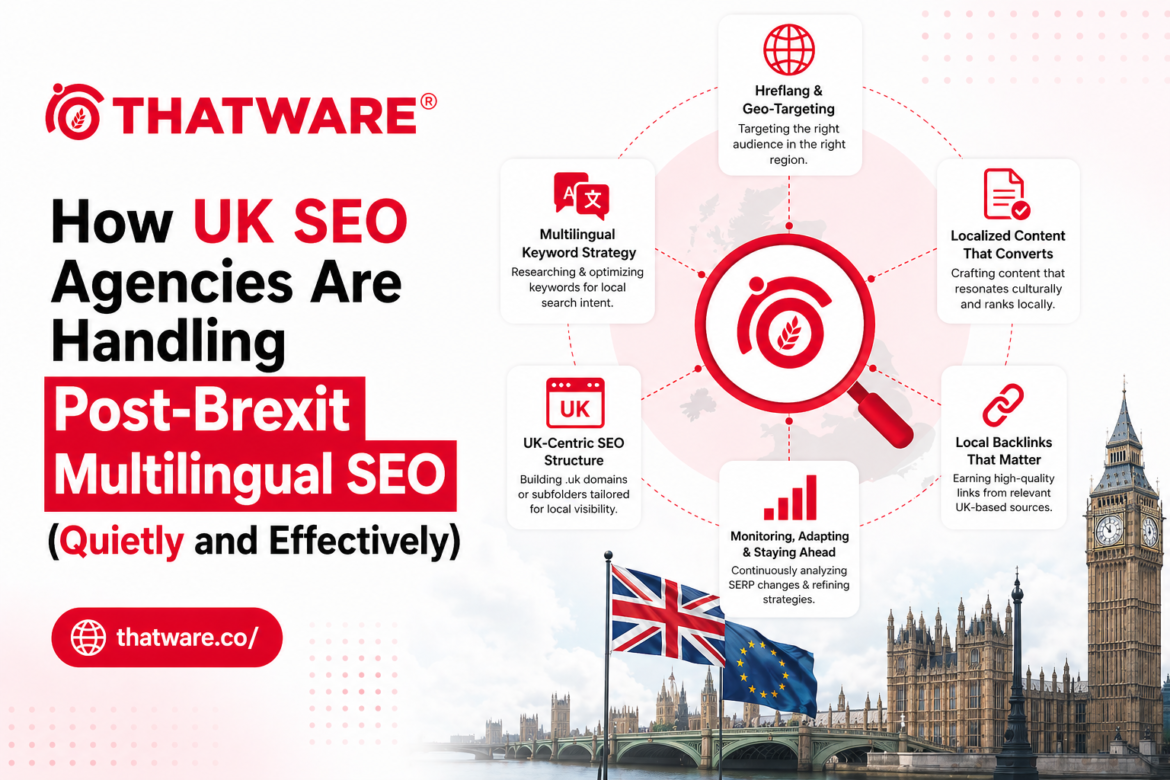
Brexit changed a lot of things for UK businesses. Some of the changes were loud and immediate. Others crept in more quietly — regulatory divergence, supply chain restructuring, the gradual reshaping of trade relationships that’s been playing out in the years since. For digital marketing, one of the less-discussed shifts has been in how UK businesses approach European multilingual SEO.
Before Brexit, many UK brands operated with a fairly unified European digital strategy. EU-wide SEO, multilingual content serving the single market, relatively clean international targeting. Since then, the picture has fragmented. Regulatory differences affect what can be said in different markets. Some UK brands have established EU-registered entities for operational reasons, creating complex international SEO structures. And the general loosening of UK-EU integration has prompted many brands to rethink whether their European digital presence actually serves European audiences or just approximates it.
The UK SEO agencies handling this well have adapted quietly but meaningfully.
The New International Structure Complexity
A fairly common scenario: a UK brand, primarily serving UK customers, had a DE and FR section of its website for European sales. Pre-Brexit, this worked well enough — the brand was operating within the EU, UK legal standards broadly aligned with European ones, and the SEO targeting was relatively straightforward.
Post-Brexit, that same brand may have a separate EU legal entity for compliance reasons. The product offering may differ between UK and EU markets due to regulatory divergence. Pricing may differ due to tariff implications. Delivery terms, return policies, and consumer protections differ. The website that served a broadly unified European strategy now needs to serve two genuinely different commercial realities.
From an SEO perspective, this creates questions that didn’t exist before: should the UK and EU versions of the brand be separate domains or unified? How should hreflang be structured when the UK entity and the EU entity have different products and policies? How should brand authority be managed when the entities need to be clearly distinct for regulatory reasons?
Seo agency uk operations that have navigated this well have developed specific frameworks for these multi-entity structures — ones that protect brand authority consolidation where possible while respecting the legal and commercial distinctiveness that post-Brexit operations require.
Content Localization for European Markets From a UK Base
Here’s a practical challenge that UK-based agencies have had to solve: producing genuinely localized content for European markets when most of the organization’s native capability is in English.
The pre-Brexit assumption was often that a marketing team primarily composed of English speakers, with translation support, could adequately serve European markets. That assumption was questionable before Brexit — it’s weaker now, because European audiences have higher expectations of genuinely local content and more alternatives than ever for brands that do feel locally authentic.
The agencies solving this well have built genuine multilingual capability — not translation workflows, but content creation partnerships with native speakers in target markets who understand the specific nuances of German, French, Spanish, Italian, and other European markets. The difference in content quality, and the performance gap it creates, is measurable.
Technical SEO for UK-EU Split Structures
One of the more technically interesting challenges post-Brexit UK multilingual SEO has created: managing technical SEO when a brand has genuinely separate UK and EU presences that share some content but have different legal, commercial, and regulatory content.
Uk seo company operations handling this have developed specific technical approaches to:
Hreflang that correctly distinguishes UK English (en-GB) from US English (en-US) and any other English variants, while correctly managing European language targets through the EU entity’s properties. Getting this wrong — which is easy to do — creates canonicalization confusion and cross-territory ranking issues.
Domain strategy that balances SEO authority consolidation (generally preferring a single domain) against the legal and operational reasons why separate domains sometimes make sense for genuinely distinct legal entities. There’s no universal right answer here, but there are wrong answers for specific situations.
Structured data that correctly represents the different entities — their separate addresses, registration details, and service territories — without creating confusion about brand identity or undermining the unified brand signals that Google uses to evaluate authority.
The Language Specifically Matters
A practical point worth making explicitly: British English and the European varieties of English used by non-native-speaker audiences are different enough to matter for content targeting.
UK brands producing English content for European audiences sometimes produce content that’s calibrated for British readers and confuses or alienates European readers who learned American or more generic international English. Spelling conventions, idiomatic language, cultural references — these create subtle friction that the best UK agencies account for when producing English-language content for non-UK European audiences.
This is a detail. But in SEO, where engagement signals are part of ranking evaluation, content that European readers engage with less well than UK readers is performing below its potential in European markets. Fixing it is low-cost and measurably worthwhile.
What’s Working Well for UK Brands in European Search Right Now
The UK brands performing most effectively in European search post-Brexit share a few characteristics worth noting.
They’ve accepted that serving European markets properly requires genuine European capability — not UK capability stretched to cover Europe. Whether that’s in-house multilingual staff, agency partnerships with European market specialists, or content partnerships with local creators, the investment in genuine local capability is there.
They’ve got their international technical structure sorted — clean hreflang, appropriate entity representation, clear territorial targeting that serves the right content to the right audience without confusion or conflict.
They’re building European link authority specifically. UK domain authority doesn’t transfer automatically to European search performance. Building local European link equity — through European industry publications, local directories, European media coverage — is an ongoing investment, not a one-time setup.
The brands doing this well have typically been doing it consistently for at least 18-24 months. The compounding nature of search authority means that those who started working through the post-Brexit complexity early are building positions that newer efforts will need sustained time to match.